
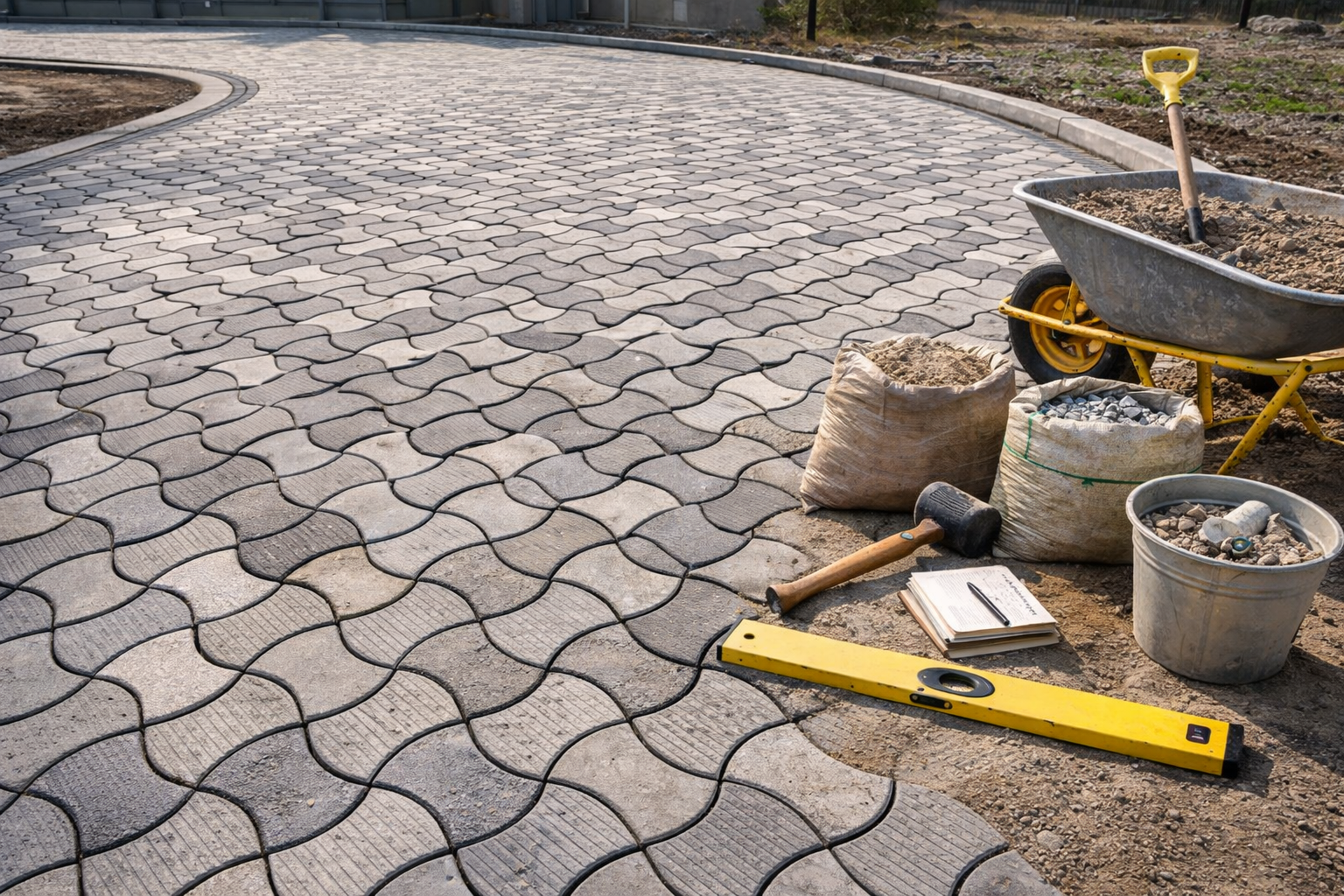
If you’ve been asking around for interlocking paving prices in Zimbabwe, you’ve probably noticed something frustrating: one person quotes “per block”, another quotes “per square metre”, and someone else just says “it depends” and disappears.
So let’s make it simple.
In real life, your final paving price comes down to three big things:
- The pavers themselves (60mm vs 80mm, colour/pattern, supplier pricing)
- The base and groundwork (this is where most “cheap quotes” fall apart later)
- Whether you’re paying labour-only or supply & fix (and what’s included)
This guide will help you understand what you’re actually paying for, how to compare quotes properly, and how to estimate a rough cost per m² without being a paving expert.
Request a Custom Paving Quote
Share your location and whether it’s 60mm (home use) or 80mm (heavy-duty). We’ll recommend the right option and send pricing.
Why Interlocking Paving Prices Feel “All Over the Place”
Two driveways can be the same size but cost very differently.
One might be on solid ground with easy access and a simple shape. Another might need excavation, extra base material, drainage shaping, kerbing, and careful cutting around curves and edges. That second driveway is more work — and if a contractor ignores those realities to give you a “nice price”, you usually pay for it later when the paving starts dipping or spreading.
So instead of chasing the cheapest number, the smarter move is: understand what the quote includes.
60mm vs 80mm Interlocks in Zimbabwe (Which One Changes Price More?)
This is one of the most common questions we get because it affects cost and durability.
60mm interlocks
These are the most common for:
-
residential driveways (normal cars)
-
patios, courtyards, walkways
-
yard paving and general home use
If installed on a proper base, 60mm interlocks are more than enough for most homes.
80mm interlocks
These are typically used for:
-
parking areas with heavier use
-
loading zones and delivery routes
-
commercial yards
-
anywhere trucks, forklifts, or heavier vehicles move regularly
80mm costs more mainly because the pavers are heavier-duty and the base spec is usually stronger too.
A good rule: If it’s mostly cars at home, 60mm is usually fine. If it’s regularly heavier than cars, go 80mm.
Labour-Only vs Supply & Fix (Big Difference)
When someone gives you a price, this is the first thing you should confirm.
Labour-only
This usually means you provide:
-
interlocking pavers (you buy them)
-
sand/stone/base materials (sometimes)
-
and they charge for installation only
Labour-only can work well if you already have a trusted supplier and you’re confident you’re buying the correct pavers and base materials.
Supply & fix
This usually means the contractor supplies:
-
pavers
-
base materials
-
labour and installation
-
plus the responsibility of getting it done correctly
Most homeowners prefer supply & fix because it’s one clear price and the contractor can’t blame your supplier if something doesn’t work out.
The Real Cost Drivers (What Actually Changes Your Price per m²)
Here’s the short list of what moves the quote up or down — and it’s exactly what you should use to compare contractors.
-
Excavation depth and soil condition
If the ground is soft, filled, or uneven, more preparation is needed. -
Base thickness and compaction
A proper base is the difference between paving that lasts and paving that dips. -
Access to the site
Tight side passages and steep driveways take longer and cost more. -
Shape and cutting
Curves, circles, edges, and tight corners require more cutting and time. -
Edging / kerbing
Without edge restraint, interlocks slowly spread outward over time. -
Drainage and levels
If water pools or runs toward the house, levels must be corrected.
That’s why two quotes can look far apart — they may not be quoting the same job.
How to Calculate Paver Cost per m² (Even if Suppliers Quote “Per Block”)
In Zimbabwe, it’s common to see interlocking pavers priced per unit.
To compare properly, you want to convert that to cost per square metre.
Here’s the simple method:
-
Find out how many pavers cover 1m² (this depends on the paver shape/size)
-
Multiply: (price per paver) × (pavers per m²)
-
That gives you a pavers-only cost per m² (no labour, no base yet)
Example (NOT market pricing, just a simple demo):
If an interlock costs $0.45 each and you need 50 per m², then pavers-only ≈ $22.50 per m².
Your supplier or contractor can tell you the pavers-per-m² figure for the specific pattern you’re choosing (especially the popular Zimbabwe interlock patterns like wave/S-shape and similar).
A Practical “Budget” Breakdown (So You Don’t Underestimate)
Most people underestimate how much of the cost is not the pavers.
Very often, your full paving job breaks down roughly like this:
-
Pavers: the visible cost (what people focus on)
-
Base + groundwork: the “invisible” cost (what makes it last)
-
Labour + finishing: edging, levels, compaction, cutting, joints
If someone quotes you a surprisingly cheap price, the risk is usually one of these:
-
base is too thin
-
compaction is skipped or rushed
-
edging is weak or missing
-
drainage/levels aren’t shaped properly
And those are the exact reasons you see interlocks sinking, spreading, or holding puddles.
Request a Custom Paving Quote
Share your location and whether it’s 60mm (home use) or 80mm (heavy-duty). We’ll recommend the right option and send pricing.
What a Proper Quote Should Mention (So You Can Compare Apples to Apples)
If you’re collecting quotes for interlocking paving in Harare (or anywhere in Zimbabwe), ask for these to be clear in writing:
-
Is it labour-only or supply & fix?
-
What thickness: 60mm or 80mm?
-
Does it include excavation and removal of soil/rubble?
-
What base material is used, and roughly how thick is it?
-
Is compaction included (and at what stages)?
-
Is kerbing/edge restraint included?
-
How are levels handled for drainage (especially near garages and doorways)?
When a quote includes those details, you can trust it more — and you can compare properly.
Which Option Gives Best Value in Zimbabwe?
If you want the most “value-for-money” setup for a typical home, it usually looks like:
-
60mm interlocks for driveways, patios, walkways, courtyards
-
Strong base preparation (don’t cut corners here)
-
Proper edging/kerbing so pavers stay locked in
-
A layout/pattern that suits the space (Zimbabwe-style interlocks are popular for a reason — they look clean and modern)
And if it’s a business site or anything heavy-duty:
-
80mm interlocks are usually worth it
Quick Answers People Ask Before They Buy (Zimbabwe Edition)
“Can I do interlocking paving on top of existing concrete?”
Sometimes yes, but only if levels and drainage still make sense and the existing surface is stable. Often it’s better to do it properly once than to trap future problems underneath.
“Is cheaper interlocking paving a good deal?”
Only if the base and edging are done properly. Cheap paving that shifts after one rainy season is not cheap — it’s double-cost.
“What’s the best interlocking paving for a driveway in Zimbabwe?”
For most homes: 60mm interlocks on a proper base with good edging.
For heavier traffic: 80mm interlocks.
So… What Should Your Budget Be?
Instead of trusting a single number online, treat pricing like this:
-
Decide: 60mm or 80mm based on your traffic
-
Decide: labour-only or supply & fix
-
Make sure your quote includes the base, compaction, edging, and levels
-
Compare quotes based on what’s included, not just the total
That approach saves you money long-term because you avoid the common “it looked fine for 3 months” paving problem.
Want a Quote for Interlocking Paving in Zimbabwe?
At Premium Paving, we install and repair interlocking paving across Zimbabwe, including Harare, Bulawayo, Mutare, Gweru, and other major towns — from residential driveways and patios to commercial yards, parking areas, and heavy-duty 80mm installations.
Request a Custom Paving Quote
Share your location and whether it’s 60mm (home use) or 80mm (heavy-duty). We’ll recommend the right option and send pricing.